Monday, July 30, 2012

Confront and Conceal by David Sanger


This book clearly describes the internal debates that have dominated Pres. Obama's foreign policy, giving plenty of fodder for the President's enemies to accuse him of a "lack of leadership."  On the other hand, it also comes close to defining an "Obama Doctrine" of a limited American role in the world and describes how the President and his team have dealt with an unprecedented series of crises.  The book includes at least three key victories for the Obama team -- the killing of Osama bin Laden, the delaying of Iran's pursuit of nuclear weapons through a cyberattack called "Olympic Games," and its managing of the conflict in Libya.  However, none of these victories came without a cost, and the book outlines some of those dire side effects.  Overall, it is a well-researched, balanced look at the President's foreign policy, and it offers a good "rough draft of history," as all political journalism does.

The title of this book doesn't quite do justice to Pres. Obama's foreign policy, but it is apt enough.  The author himself doesn't use the phrase very much in the book, if at all, but it does describe Obama's strategy in some cases.  If there is an "Obama Doctrine," it could reasonably be described as "confront and conceal," meaning that the President is not afraid to confront American enemies through tough action, such as drone strikes and cyberattacks, but that he tends to keep those actions secret. While the author faults Pres. Obama for not communicating a grand strategy for American power in the world, he generally asserts that his problems in foreign policy arise from the world he inherited from Pres. Bush -- an involvement in two ground wars in the Middle East, the virtually unchecked rise of China as a global economic and political power, the lack of engagement with North Korea and Iran, which were labeled as part of the "axis of evil" by Pres. Bush, and so on.  The author asserts that Pres. Obama has adapted his foreign policy to events such as the uprisings in Tunisia, Libya, Egypt, and Syria -- the Arab Spring -- since taking office, but that the "big questions" in many cases remain unanswered.  That is probably true, given the way Pres. Obama has reacted to each revolution individually and was caught by surprise on numerous occasions -- how could the President define answers to the big questions given the fact that the world is continually bringing new challenges to his plate?

I don't have the expertise in foreign affairs to judge the accuracy of the author's conclusions, but I can say that the book seems well-researched and fairly well balanced.  The author clearly talked to several key administration officials, including Secretary of State Hillary Clinton and Pres. Obama, and he describes the internal debates in the administration with clarity and precision.  He tends to view the world through a Washington lens, which presumes that the U.S. ought to have a leading role in the world, but he is doing most of his reporting from Washington, so that kind of makes sense.  Perhaps the biggest "surprise" in the author's view is that Pres. Obama views the U.S.'s role as more limited than other Presidents have, and has fought to narrow the definition of American interests and wind down the wars.  In my view, though, the President deserves a little more blame for telegraphing the U.S.'s timetable for withdrawal in Afghanistan, which emboldened the Taliban and other enemies in Afghanistan and Pakistan.  The President wanted the world to know that the U.S.'s commitment to Afghanistan was not "open-ended," but in announcing a timetable for withdrawal, he pretty much gave the enemies of the U.S. a reason to think that we would simply walk away from whatever gains we have made in the country -- we became another occupying force that was not interested in remaking the Afghan society and that the Taliban could then claim victory over.

The book gave me a greater appreciation for the challenges facing the President in foreign affairs, and how much effort and debate goes into each international crisis.  The President's leadership in foreign affairs is under attack in the current election cycle, but he has done well, I think, overall, in trying to reduce expectations that the U.S. can continue to be the world's guarantor of security at any price.  However, there are some real problems with the President's approach, one of which is that the rest of the world really isn't ready to step up to solve some of these problems, such as Libya, and another is that commitments made in other parts of the world, such as Afghanistan, are going to have to be broken.  The author argues that we could leave Afghanistan in much the same condition as we found it, still a "petri dish for terrorism."  He also states that Pakistan is a much more important strategic problem than Afghanistan, and things haven't been going particularly well there since the bin Laden raid.  

I pretty much skipped the final chapter of the book on China and North Korea -- I think the author might have gotten too much detail from the Wikileaks release of secret diplomatic cables, so that chapter got a little too complex for me -- but I think the overall picture the author paints of Pres. Obama wanting to "pivot" toward East Asia but being frustrated by squabbling Chinese officials who always manage to deflect the blame or responsibility for any concerns the Americans might have seems accurate.  

The biggest victories of Pres. Obama's foreign policy -- the killing of Osama bin Laden, the largely successful cyberattack on Iran's centrifuges that delayed the development of an Iranian nuclear bomb, and the successful deposing of Qaddafi in Libya -- all have some negative side effects, and none of them are unqualified successes.  Perhaps that is the nature of foreign policy, that even the victories raise challenges, and nothing is as simple as it would seem.  I appreciate the book's perspective in raising some of those questions and shaping my understanding of how the President has handled these challenges.


Also, I noted this quote, that accurately describes "progressives" around the world, in the context of explaining how the Muslim Brotherhood was so successful electorally after the protests in Tahrir Square brought down Egypt's Hosni Mubarak: "One thing that most progressive political activists have in common, whether it was the McGovern campaign or Occupy Wall Street, is they don't really like politics and they somehow think that if they just show up and speak eternal truths, people will agree with them."  I found that observation particularly ironic right now.

Thursday, January 05, 2012

The Information: A History, A Theory, A Flood by James Gleick

The Information is a terrible title, but it disguises a brilliant book.  With clear storytelling and thoughtful analysis, James Gleick demonstrates the power of information and traces its development throughout history. While the prologue mentions the invention of the transistor and the "bit" in 1948, Gleick begins his story with information that was passed along in a pre-literate society through African "talking drums," metaphorical message bearers that share some characteristics of encoded messages today.  From there, he expounds on cuneiform tablets that contain what we would call algorithms, compares the first dictionary ever compiled to the modern online Oxford English Dictionary, and devotes a poignant chapter to the story of Charles Babbage and Ada Byron Lovelace, the daughter of the poet Lord Byron.  The pair theorized about programming as part of an exchange centered around a mechanical "difference engine" in the 1800s, before electricity was well understood.  Ms. Lovelace died young put peered briefly into the future, and Mr. Babbage never did complete his engine.  Still, they were precursors to modern day computing.  The hero of the book is Claude Shannon, the inventor of information theory (a mathematical concept of information that reveals it to be a lack of predictability) and the bit (a unit of information that can be expressed as a binary choice between one state and another -- 0 or 1).  Gleick traces the scientific and mathematical development of information theory, then explains how that theory informs and enlivens the sciences and culture from 1948 forward.  The explanation of the mathematical theory requires an in-depth look at Turing's hypothetical machine, but Gleick does not focus on the advances in hardware throughout history.  Instead, he describes the "software" of information, from the telegraph operator's codes and compressions through to Google's search engine algorithm, which views links among web pages as "recommendations."  In the process, he illuminates science and several scientific theories in a new way -- the gene, for example, is seen as information, while quantum mechanics make an appearance in a chapter on quantum computing.  Gleick's ultimate goal is to guide readers to an understanding of information as a whole, and in the process he puts us through our paces in our efforts to understand him.  It's hard to keep up, but the driving intellect behind this book keeps aiming at a higher and higher understanding of the concept.  Ultimately, he makes his case that information is the key discovery of the 20th century, based on advances in science throughout history, and leading to a "flood" of information in the 21st.  Similar to Newton's discoveries in the 16th century, the "discovery" of information promises a sea change in history.

Tuesday, November 29, 2011

The PEN / O. Henry Prize Stories 2011

This short story collection is surprisingly political.  I only sampled a few of the stories, and aside from one top pick, "Your Fate Hurtles Down at You" by Jim Shepard, they all had a political edge to them.  All in all, I liked them for being "fierce" stories, as editor Laura Furman writes in her introduction to the collection, but after a while it became obvious that the panel that picked the stories had a bit of an axe to grind.  They chose stories with liberal themes or preoccupations -- one story, for example, imagined a world after global warming in which food was scarce in Britain, complete with an attempted rape and many other unexpected horrors in a world with few resources; another imagined a horror of horrors in Budapest at the end of World War II.  Rape or the threat of rape seemed to hang over many stories.  One story I skipped was entitled "Melinda" -- just from the title, I feared that it would be about rape, but from the description at the back of the book it seems to be about a meth addict.  I'm not sure I need to be exposed to this kind of fiction, no matter how adult I am or sophisticated as a reader.  The most important short stories are about people who break rules.  I understand that.  I just don't see the need to be badgered in fiction.  The story I liked the best was the aforementioned "Your Fate Hurtles Down at You," which studiously avoids the politics of the Alps in the 1930s (not very pretty politics, I assure you).  It is a fierce story without being polemical or obvious.  It continually surprises with subtlety and tension in a set of family dynamics that matches the tension in the snow before an avalanche.  The extended metaphor of the avalanche dominates the story, and it makes for compelling reading.  I am glad I bought the book just for that story, but I can't say I recommend the whole collection.

Wednesday, June 22, 2011

People of the Book by Geraldine Brooks

This novel traces the roots of a remarkable book, the Sarajevo Haggadah, through several hundred years of history.  More importantly, it brings the creators of the book to novelistic life through the imagination of the author.  It also tells a taut, dramatic story about the restoration of the book in the modern era, centering around a young fictional Australian expert named Hanna Heath.  Hanna's story could stand alone as a novel all its own, and it provides quite a bit of drama in the end parts of the novel.  It also allows us to see the survival of the book through to contemporary times, and that it is always more complicated than we would expect for something like the Haggadah to survive.  The "people of the book" are Christian, Muslim, and Jewish, and the survival of the Sarajevo Haggadah tells of the complex interplay between these faiths.  First of all, the book is Jewish, but it is illustrated in a style influenced by Christian prayer books, or books of hours.  It ended up in the hands of Muslim caretakers, and the novel ultimately traces the art back to a Muslim source, although that supposition is not proven as it would be in a non-fiction work. The creators and preservers of the book come into the book through artifacts that are found in the binding or on the pages when Hanna restores the book -- she finds a butterfly wing, for example, that leads into a story of survival during the Nazi era. 

Saturday, June 04, 2011

Decision Points by George W. Bush

The 43rd US President's memoir conveys quite dramatically some key decisions of his time in office.  The transformation of the Presidency from peacetime to what the former President calls a "war footing" is striking.  The first few chapters focus on Pres. George W. Bush's family life, the decision to run for President, and stem cell research.  Then, he describes learning of the attacks on September 11 while attempting to promote testing in public schools, and the book shifts into a different gear. The former President attempts to describe the way September 11 forced him to confront some stark realities, in a chapter entitled, "A Day of Fire," but it skirts some other important issues.  The use of what Pres. Bush terms "enhanced interrogation techniques" and others have called torture gets some explanation, but Abu Ghraib and the abuses there get about one sentence -- an off-hand reference when someone says Guantanamo is "no Abu Ghraib."


Wednesday, March 16, 2011

Deal Breaker by Harlan Coben

I found this book at the local bookstore -- they were featuring the author at one of the front displays.  It is the first novel in a crime series that centers around sports, specifically through the detective/investigator in the case, sports agent Myron Bolitar.  The novel made me want to keep reading, and really was a page-turner in the best sense of the word.  The plot centers around the disappearance of a young woman from a college campus -- she was the cheerleader dating the star quarterback, who happens to be Myron Bolitar's first big client as a sports agent.  Myron is funny and sarcastic in the first scene, in which he negotiates with the team's owner over the quarterback's contract.  This disarming humor throughout the book helps keep readers on Myron's side, even as he and his sidekick/enforcer, Win, descend into some dirty business and commit acts that could be called morally questionable.  The morality level isn't too heavy in this one, though -- it's clear there are good guys and bad guys, and the scenes showing prostitution and drug dealing go out of their way to make those crimes seem completely unappealing.  The author does the standard crime novel trick of releasing just enough information to leave readers guessing, right until the very end.  The twist at the end was a surprise, at least to me, although I probably should have seen it coming.  I am not very good at guessing these things, but I had some hunches that turned out to be right.  Overall, this novel is a very entertaining read.  I noticed a few details from the early 90s that stick out now as outdated, but the novel holds up pretty well with all the changes we've been through since then.

Monday, February 21, 2011

Anne Frank: The book, the life, the afterlife by Francine Prose

This interesting book re-introduces Anne Frank as an intelligent, observant writer and her diary as a work of art.  The author divides her book into three sections -- the life, the book, and the afterlife -- and devotes a final section to teaching the diary in classrooms and college.  The book made me want to attempt to tackle the diary in the classroom again -- the closest I got was showing a film called Anne Frank Remembered (a more complete version of her story than other documentaries) as part of a non-fiction unit.  It is a complex work, though, and putting it in historical context is difficult.  Reading the diary as a whole is something I've never really done -- I've been informed mostly by a dramatic version I saw in high school and excerpts from various textbooks and study books, and I agree with the author of this book that the play oversimplifies the realities of Anne's life and the reasons she was in hiding.  I may go back to the original diary and read it if I get a chance now.  Reading this book inspires a healthy respect for Anne Frank as an author with a self-conscious desire to be published.  A key revelation in the book is that Anne Frank herself went back and revised her diary, intending it to be published at some point.  She recognized that, even if she were "an oridinary girl" in extraordinary circumstances, her story has relevance beyond the walls of her "secret annex."  Her observations of herself and her companions in the annex make for vivid stories, and they symbolize what was lost in the Holocaust in very personal terms.  But beyond that, the work of her diary is to record the humanity and civility of a group of people, the vast majority of whom did not survive the Holocaust, and to document in terms of daily life the privations they endured.  She also explores herself and wishes for things to be different than they are, as most adolescents do, but in a specific context that crystallizes her wishes in very concrete ways.  The fact that her final entry, in which she wonders what she would be like if there were no one else in the world, is her final entry, reminds us that her story ended not in the way she wished but in Bergen-Belsen, a horror of horrors.  It is not enough to wonder what kind of writer Anne Frank might have been had she lived; rather, we have to wonder at the kind of writer she already was, and at the inhuman extermination edicts that placed her in such difficult conditions.  Anne Frank is not an easily reduced author.  She is not the poster-child for optimism that is represented in the play and film versions of her diary, nor is she a saint or a sex-obsessed teenager, as some have made her out to be.  Instead, she is a human being, a Jew, an author who lives on in her work.  That message came through in clear, direct language in Prose's book, and I am grateful for the portrait she offers of Anne Frank, the author.

Tuesday, February 01, 2011

At Canaan's Edge by Taylor Branch

This third book in the monumental series depicting "America in the King years" offers an amazing look into the struggles and real-life complexities of Martin Luther King, Jr's life.  The book does not shy away from awkward facts like the internal struggles against King's Poor People's Campaign in 1967-1968, or his "casual affairs" with women who were not his wife, but it does portray the civil rights struggle in such vivid detail as to give it new life.  The author does downplay those affairs a little bit, sometimes failing to name the woman with whom King was having the affair.  The overall effect of the book is to bring King into focus as a central figure in American history, who has failings like many others but whose  doctrine of non-violent protest of injustice brought about sweeping change in the country.  The villain of the story is definitely J. Edgar Hoover, who actively opposes King's campaigns, planting bugs and wiretaps to record his operations and glean embarrassing details, and often plants stories in the press in an attempt to discredit King.  The book does venture into some explanation for the reasons why civil rights became such a struggle, but it mostly sticks to the narrative, which is compelling in various ways.  First, there are the stories of pioneers who face hardship and suffer martyrdom in rural counties in Alabama in an effort to win voting rights.  Second, the dramatic march for voting rights from Selma to Montgomery in 1965 is portrayed in vivid detail as the "last revolution" of the civil rights movement.  King's oration upon finally arriving at Montgomery is particularly well described.  Finally, there is the Vietnam War, which enters the story through the Johnson White House.  Apparently, the White House was full of gloomy predictions about the prospects for success in this war, even as the President is asked for more and more troops to be committed.  According to this book, the war comes to dominate thinking on a national level and eclipses civil rights as the Johnson administration's focus.  The war is also one reason given for the failure of a protest march in Chicago to ignite a national debate on Northern racism.  These stories are important to remember in our era of supposedly post-racial politics.  It is true that we have come a long way from the 1960s, but we still have a long way to go.

Saturday, October 23, 2010

The Story of Edgar Sawtelle (1/3 through)

I took this book along on a recent trip, but only managed to get through about 1/3 of the book.  It is a dense book, full of beautiful descriptions of scenery and the inner workings of a small, Midwestern family.  I have had a few obstacles to enjoying this book -- first, it is a heavy book, meaning that the story it tells is not an easy one.  People and dogs die, even in the very first scene, and the emotional weight of issues like infertility and living with a handicap can be felt early on, too.  Second, the book jacket gave away a plot event that appears about 1/3 of the way into the novel.  I was so disappointed that I read the book jacket and it gave away this plot point that I had to put the book down for a couple of days.  Finally, it is a retelling of a classic story, which I only put together because of a hint my sister-in-law gave me.  I think I sort of know what is coming next because of this, so it takes away some of the drama of the story.  With all that said, though, I am determined to like this book.  It is well-written, with intricate details and an imaginative take on the subjects of dog-rearing, death, and betrayal.  The dogs are central characters, so some people may have a problem with that.  One early chapter is told from the perspective of a dog, which is an attention-grabbing stunt but also an important clue as to what the author is trying to do.  He's building layers of meaning into the story that go well beyond the plot points.  It does seem to take a long time for something to happen, but the author is really building the emotional worlds of the central family and their dogs.  Edgar Sawtelle, the central character, is born mute, and develops his own sign language that his family and friends (especially the dog Almondine) learn to read and speak.  This is a fascinating way of recreating a character who is central to the plot (to give his name is to give away too much).  There are hints throughout as to what story is really being told here, but I don't want to spoil anything for anyone else.  Let's just say there is an Uncle Claude and a mom named Trudy.  That may be enough for some people to put together the story that is being told.  I'm looking forward to the rest of the story unfolding in this unique way.

Monday, August 09, 2010

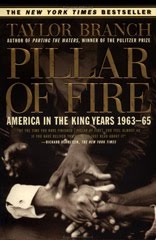
Pillar of Fire (all the way through)

This remarkable volume, the second of three books, traces the middle stage of Martin Luther King, Jr's civil rights struggle and contextualizes the struggle as part of a grand arc of history -- an arc that "bends toward justice," to apply a quote from Dr. King himself.  The book describes efforts to gain rights we often take for granted now -- the right to vote, the right to eat in desegregated restaurants, the right to express ourselves without fear of government reprisal -- bringing the struggle to vivid life with well-researched details.  The narrative centers around the movement in the South, but brings in perspectives from around the country and begins to indict Northern racism as well as the institutional racism of the South.  Malcolm X's rise to national prominence begins with a violent episode in Los Angeles and ends with his death in Harlem.  The detailed account of the often violent struggle for control of the Nation of Islam that Malcolm X engages in and his changing understanding of Islam and the need for a more "militant" response is an interesting counterpoint to Martin Luther King's struggle to make decisions in the best interest of the non-violent movement.  President Lyndon Johnson's role in the book begins with a visit to St. Augustine, Florida, as Vice President, where he is the reason for an integrated dinner that sparks later movement activity, and ends with his battle for control of South Vietnam heading toward outright war.  Robert Kennedy, the Attorney General, and J. Edgar Hoover, director of the FBI, spar toward the beginning of the book over turf within the White House, and Hoover's active opposition to King through FBI wiretaps is ultimately triumphant; these wiretaps are ultimately revelatory (see below) and essential to the history of the movement.  The wiretaps reveal the inner struggles of the King circle, as well as some personal failings of King's, and they also reveal the Hoover FBI's ability to use "extralegal" means to control what Hoover considered subversive activity.  The implacable opposition faced by nonviolent protesters attempting to overcome segregation astounded me with its vehemence, violence, and blatant injustice.  The pivotal summer of 1964 begins with the murder of three Mississippi civil rights workers, and the efforts to bring these murders to trial face stunning opposition -- Mississippi authorities claim the nonviolent workers were faking the disappearance until the bodies are discovered, and even after the discovery of bodies, Mississippi authorities blame the victims for the crime.  That outrage is just the beginning of the legal saga that is unwound in the epilogue of the book -- the FBI did get some convictions in the case after years of struggle, but no one goes to prison for life because of these murders.  There are numerous heroic stories of pioneers in the civil rights movement who suffer punishment for their involvement in the movement -- one particularly tough pill to swallow is the story of Vernon Dahmer, who is murdered at the end of years of providing support for the movement, after the voting rights act is passed in 1965, essentially for offering to pay the $2 poll tax for those who can't afford it.  The hero of the story, aside from Dr. King, is probably Bob Moses, the pioneering educator who begins a lonely campaign to bring voting rights to Mississippi in the early 1960s, then operates as a key leader in the "Freedom Summer" of 1964, which ultimately brought a Black delegation to the Democratic National Convention in a showdown that tested how far the country could go to accept Blacks voting in large numbers in the South.  Moses is one survivor in the epilogue who makes a positive impact in the 1990s.  Which does not mean this is a downer of a book -- gripping, yes, depressing in some ways, but also inspirational and true.  The research and detail make for a compelling read.  If you are willing and able to put in the time, it is well worth the read.

Wednesday, August 04, 2010

Pillar of Fire (halfway through)

This book requires some extra concentration, so reading it before bed-time has resulted in my falling asleep many times.  However, I had a chance to put a significant dent into it this weekend, and I really learned in great detail about the civil rights era and Martin Luther King, Jr.'s, impact on it.  The violence the book describes is astonishing, similar to the first installment, Parting the Waters, reviewed here.  The book opens with a very detailed account of a violent incident in Los Angeles, which accompanied the rise of Malcolm X to national prominence.  The first five chapters explore the connections between several disparate events, leading up to a climactic confrontation in Birmingham, Alabama, between King's non-violent volunteers (mostly youth) and police armed with dogs and fire hoses.  The main arc of the narrative centers around the national civil rights struggle, and the cast of characters is immense.  J. Edgar Hoover has a starring role as a vindictive, mean-spirited man haunted by the specter of American Communism well after its influence has waned.  The tape recordings he has made using wiretaps and bugs in hotel rooms and offices, including one of King's extra-marital affair and private observations about the Kennedys, are devastating to those who see King as a modern-day saint, but the overall picture he paints of a real human being both buffeted by events and shaping them is worth the shock to the system caused by the revelations in King's private life.  I have just reached the point of beginning the section on "Freedom Summer," a project to promote voting rights in Mississippi involving student volunteers from around the country, which spills over into national implications, and I am eagerly anticipating the rest of the book.  The story is complex and filled with surprises, so I am enjoying learning so much about this history, which is not so distant in the past.

Sunday, July 18, 2010

The Italian Secretary

This short novel was a quick, entertaining read, but I expected a little more subtlety than I got in the plotting and the examination by the eminent Sherlock Holmes of the crimes committed.  The author, Caleb Carr, was commissioned to write an additional mystery featuring Sherlock Holmes and Dr. Watson, and he did a workmanlike job of writing in Dr. Watson's old-fashioned voice and making it seem authentic.  My favorite thing about the book was the setting -- the descriptions of Edinburgh and Holyroodhouse were intriguing, and helped to tell the story.

The most disappointing aspect of the book, though, were the clues that Mr. Holmes followed in deciphering the crime -- most of the clues dropped in the book turn out to be red herrings, and the ones that ultimately solve the case are not necessarily obvious, but not so subtle that they would require Mr. Holmes to use his highest powers of observation and experimentation.  Also, there are some loose strings at the end that are not tied up, and Holmes and Watson are not involved in the final capture of the murderer in the direct way that I would expect.

Sunday, July 11, 2010

Getting Organized in the Google Era

I read the first few chapters of this book before getting discouraged.  I decided that if I tried to write a book on getting organized (which is hardly my strong suit) I could do about as well as this guy.  He doesn't have any secret formulas, just a set of principles that seemed pretty elementary.  They didn't seem to match the promise of the book and seemed more as a transparent effort to cash in on the author's role as a former CFO at Google.  Maybe after reading the whole book I would have more respect for the effort involved, but really, the book just annoyed me more than I could stand.  The author does try to keep things light, but his attempts at humor really just got in the way.

Monday, May 03, 2010

Paul Celan: Poet, Survivor, Jew

I re-read this long, intense study of an important German-Jewish poet over the last two to three weeks in honor of the professor who wrote it (John Felstiner), who is retiring this month from teaching at Stanford.  This professor was the closest thing I had to a mentor at Stanford, but I really only knew him from taking two classes that he taught.  He taught on poetry in a way that invited students to read poems closely, and his poetry selections were interesting and varied.  He also taught a course entitled "Imagining the Holocaust" that attempted to put the Holocaust in context with the works of survivors as the centerpiece.  That is where I first was introduced to Paul Celan's poetry, specifically "Todesfuge," or "Death-Fugue," which imagines the Holocaust very specifically in a German poem.  The professor played a recording of the poem, which he reads closely in the book, and I remember being impacted by the reading.  The poet was not very loud or overly dramatic, but the poem itself has a definite rhythm that adds an emotional charge.  The book re-creates that charge, interestingly, by translating the poem into English, but working the original German words back into the poem -- the repetition of words in the poem allows this, and the "regression" so to speak back into German identifies the specific nature of the poem.  The poem is about the death caused by Germans, so it is fitting that it should end with German language, even in translation.  This kind of innovative yet true translation is at the heart of this book, which tackles Celan's life through his poetry.  The book makes the poems come to life for those of us who don't know as much German as we would need to translate Celan's poetry.  Celan's poetry is difficult because it is quite often very spare -- it uses so few words as to be mystifying.  Yet still, the poetry speaks to the condition of the German language after the Holocaust, and attempts to bring the truth of the man-made disaster into the language without diluting its horror or softening its impact.  The poet spoke in one of his speeches of the difficulty of writing poetry in German after "the thousand darknesses of death-bringing speech."  This book clearly examines Celan's poetry to illuminate the process the poet went through in trying to accomplish this project.

Monday, March 15, 2010

Fearless by Max Lucado


I read this book with relatively high expectations.  I hoped to find answers to some of my problems with fear -- the fact that fear drives me to a certain extent, and that I feel constrained by fear, especially when it comes to money.  The promise of the book is that it will teach us how to live a life without fear, and it delivers on that promise to a certain extent.  However, it falls short of being a life-changing treatise that alters my worldview completely.  The book does address specific causes of fear, including money, and the answer is always to turn to Jesus in some way.  The simple Biblical truth that this book addresses is that every fear (except the fear of God, which is another word for faith) can be lessened if we look to Jesus, the Holy Spirit, and God the Father for answers.  That truth is expressed gracefully, with style, and with compassion.  Still, I am hungering for more truth on the nature of fear.  Why does God allow us to be so ruled by fear?  The author does touch on the fact that fear sometimes plays a useful role in warning us of dangers.  But he doesn't delve deep into the psychology of fear, how rooted it is in our experience.  In a way, fear is the only appropriate response to the human condition.  Still, I wonder if that's purposeful -- that the author knows not to dwell too much on the deep-rootedness of fear, because his philosophy and advice is simple -- trust God, no matter what. 

Tuesday, March 02, 2010

American Rust by Philipp Meyer


American Rust starts with a killing that could be called self-defense.  The plot flows forward from this single event and remains taut until the final conclusions are reached.  The point of view bounces back and forth in stream-of-consciousness style from the two main characters, 20-year-old Isaac and 21-year-old Poe, to their family members and the police captain, Bud Harris, who is charged with cracking their case.  Isaac, a smallish, smart kid whose mother has committed suicide before the novel opens, lives with his wheelchair-bound father in southwestern Pennsylvania.  His sister, who escaped to Yale shortly after her mother's suicide, also makes an appearance about a quarter of the way through the novel.  The father's and the sister's perspectives don't add that much to the novel, but they are important in telling the story.  Poe, a former star athlete, lives with his mother, Grace, who also becomes a focus of the narration.  She becomes the wheel around which Bud Harris turns (they have an on-again, off-again relationship at the beginning of the novel).  She ultimately shifts his actions toward the unthinkable.  The setting dominates the novel -- the broken-down steel mills being reclaimed by nature, the beauty of the hills around the fictional town of Buell -- as every character takes note of the setting at various points in the novel.  There are heavy overtones of American decline -- hence the title.  The book creates many murky moral dilemmas and contains difficult, life-affirming or life-denying choices.  It earns the category of serious literature because it doesn't shy away from these painful realities.  The content of the novel is a little like John Updike's -- lots of sex, well-drawn characters who make bad decisions -- but without the comic turns.  The novel opens with quotes from two existentialist authors (Kierkegaard and Camus), so there is a little too much existential angst in the novel.  Still, the author does write a gripping tale, and I have to give him his due in drawing me in to a story that gave me plenty to chew on.

Wednesday, January 27, 2010

The Alchemyst by Michael Scott


I read this book on a recommendation from my sister-in-law, an avid reader and middle school teacher.  I enjoyed it, primarily because it fits all the action of a good fantasy novel into a relatively short, easy read, but I was disappointed with the ending.  It's definitely a young adult novel aimed at teenagers, but it has appeal beyond young adults if you're okay with a little modern language and technology mixed in with your fantasy world.  The plot of the novel centers around two twins, who find out they are working for Nicholas Flamel and his wife in separate shops at the beginning of the novel.  Nicholas Flamel is the famous alchemyst of the title, who has been brewing a potion since the Renaissance in order to keep himself and his wife Perenelle alive until the modern day.  Soon, the twins are transported into a fantasy world populated by Elders (including a vampire assassin on the good guys' side -- probably my favorite character) and other mythological creatures.  The novel draws toward a close with a climactic battle in a parallel world almost entirely inhabited by these mythological creatures, which is inventive and different than other things I've read, but also a little disappointing because the battle doesn't resolve everything, and we're soon brought back to the "real world" without having every question answered.  I'm being a little vague on purpose because I hate giving away endings, but just know that if you really like the book, you'll probably have to buy the whole series to get all the answers you want.  The writing is pretty good and the pace of the plot is fast, so I recommend the book overall to anyone who wants to enjoy a new take on the fantasy genre from a young adult's perspective.

Saturday, January 09, 2010

The Magician's Elephant


I read this book over Christmas, in the midst of many distractions.  It grabbed me from the first sentence, which I had read on Amazon before putting the book on my Christmas list, and continued to add layers as I read.  The first chapter sets the stage for the rest of the book, daring to make its readers care about small things.  A single decision focuses the chapter, allowing the author to weave in background and meaning while asking the question, What if?, which becomes a theme of the book.  The young man who makes this small decision, with a musical name and a difficult childhood, resonates with Oliver Twist and other Dickensian characters.  He also has at least one flaw (his earnestness), like every character in the book.  The book brings out magical realities, an essential part of childhood, but it is not really a children's book.  The elephant in the title becomes a key character in her own right, symbolizing alternately a war, a catastrophe, hope, despair, and creativity.  The multi-layered symbolism keeps this from being a straight allegory, but every character certainly has representative qualities.  I recommend the book for its poetic quality and thoughtfulness, even if the uplift the book is looking for isn't quite there in the end.

Monday, October 19, 2009

Parting the Waters: America in the King Years 1954-1963


Reading this book affected my view of the civil rights struggle profoundly. First, it introduced me to the spirit of the non-violent movement, which was not orderly at all but somewhat chaotic and full of internal debates and rivalries. Then, it shocked me with the level of violence perpetrated against those who were demonstrating for rights I had taken for granted. The description of segregationist mobs who attacked the Freedom Riders, in particular, and out-and-out violence and intimidation against civil rights protesters in general made me think twice about my perception of an empathetic response to the civil rights movement. Many white Southerners were blinded by hatred and bigotry to the extent that they would justify atrocities to defend segregation; there was precious little empathy in the response to the protests. Finally, the book opened up the federal government's response, including anti-Communist paranoia at the FBI under J. Edgar Hoover and quite a bit of foot-dragging on the part of the Kennedys in responding to the civil rights movement's activities. The march on Washington, which established Martin Luther King as a national leader capable of swaying the nation, also resulted in very little specific progress on the civil rights bill, in part due to the Kennedys' dependence on Southern Democrats who were also segregationists. The chapter after the march on Washington is entitled "Dreams and Nightmares" and puts the "I Have a Dream" speech in context with the Birmingham church bombing that followed close on its heels. The story as a whole is gripping and intense, and despite the huge cast of characters (history isn't as simple as a novel), it provides a powerful insight into how this change in American life came to be.

Saturday, August 29, 2009

Three Books I Haven't Quite Finished

I started two books this summer and attempted to get through more of a third:

Personal History, by Katherine Graham, publisher of the Washington Post during the Watergate years and wife to a manic-depressive husband. As soon as I learned her husband was manic-depressive, I stopped reading the book. I guess I didn't want to know more about her husband's suicide and her "failures" to get to the bottom of his issues. The book was interesting enough, but it has a real sense of entitlement throughout. Ms. Graham really does believe the Post is the best newspaper in the world and that she was instrumental to that development, apparently. I didn't finish the book, but she was enormously proud of a business deal early on that I felt was more important to her than to the quality of the paper -- a merger, of all things, between two different Washington papers that gave the Post a dominant position in the "morning" slot. That may have been key to the Post's success, but it seems so prosaic compared to the romantic view I have of newspapers as guardians of the public trust, not as businesses. So this book opened my eyes to the business side of things, but it's not something I really wanted to have happen.

Next up was Ulysses, which I continued reading for a little bit before putting down again. I read up through a lengthy discussion of Shakespeare and some avant-garde interpretations that are more or less accepted as fact by the general public nowadays -- that Shakespeare was gay, that he was a Catholic, that he was a woman-hater. I do think Shakespeare was Catholic, but the "gay" concept is ahistorical, and the woman-hater charge is pure bollocks. Anyway, the lengthy discussion kind of wore me out as a reader, but I may try to get back into the swing of this novel again later.

Finally, there is Parting the Waters, a brick-sized volume on "America in the King Years" that is riveting in parts and mind-numbingly complex in others. The factual description of the violence perpetrated against the early Freedom Riders in particular is stunning. The book describes the chaos and confusion of the early King years, and I'm looking forward to the triumphant March on Washington. The complexity of the story, though, is threatening to overwhelm me as a reader. Maybe I'll take a page from Monty Python and "skip a bit."